29
2016
-
07
Applications of Truss Robots
The truss robot, also known as the gantry robot, belongs to the category of Cartesian coordinate robots. It can achieve automatic control based on a spatial XYZ Cartesian coordinate system, is reprogrammable, has multiple degrees of freedom, allows for orthogonal movements between each other, and is multifunctional and versatile. It is capable of transporting objects and operating tools to complete various tasks.
Truss RobotAlso known as gantry robots, they belong to Cartesian coordinate robots. They can achieve automatic control based on a spatial XYZ Cartesian coordinate system, are reprogrammable, multi-degree-of-freedom, capable of orthogonal movement between each other, multifunctional, and versatile robots. They can handle objects and operate tools to complete various tasks.
Truss RobotIt has changed traditional logistics methods, effectively improved the working environment, provided digital, informational, and reduced human management of parts processing, reliably ensured product quality, greatly increased labor productivity, liberated workers from heavy physical labor, and brought modern manufacturing technology to a new level. Meanwhile, China's current severe employment environment: the continuous increase in labor wages, the ongoing large-scale labor shortages, has led more and more enterprises to adopt robotic automation in production.
In modern industry, automated production is increasingly becoming mainstream.Robotsas the main body of flexible manufacturing technology, namely robotic automation equipment, is an inevitable trend. The robotics industry will be a sunrise industry, and future industrial production will gradually evolve into robot technology-dominated industrial production, freeing humans from monotonous and complex physical labor to engage in more creative work.
Automated production linesand highly automated processing equipment have become an inevitable trend for future manufacturing factories. Single and ordinary dedicated processing machines are increasingly being replaced by standardized machines and flexible automated production lines during mass processing.
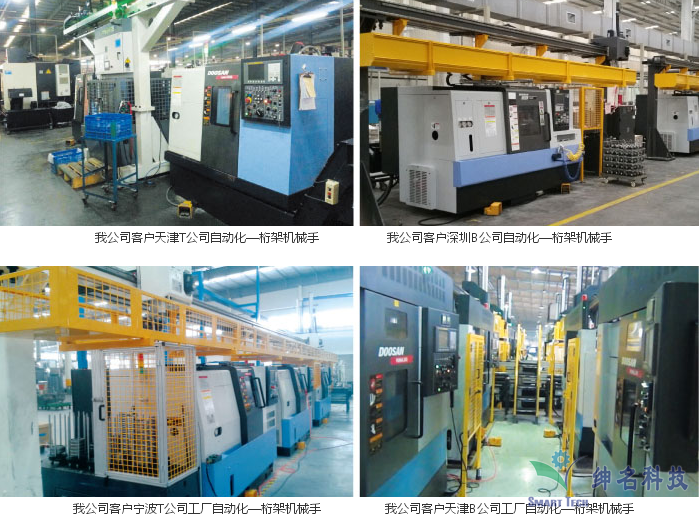
For example, inCNC lathes,machining centers, CNC grinding machines, honing machines, etc., the raw materials may weigh several kilograms or even hundreds of kilograms, and the frequent loading and unloading of small parts, as well as the handling of large motor housings, engine housings, and reducer housings, are time-consuming and labor-intensive, directly affecting work efficiency, machine utilization, and production safety.
Currently, the handling of such components has already been automated in developed countries such as the US, Europe, and Japan. In the field of robotics and automated industrial production, truss robots have achieved complete automation of the manufacturing process and adopted integrated processing technology, suitable for loading and unloading of machine tools and production lines, workpiece flipping, and workpiece sequencing. At the same time, their high-precision clamping positioning tool system provides a standard interface for robotic automated processing, with a repeat positioning accuracy of 2μm ensuring high precision, high efficiency, and consistency of mass-produced products.
Truss-type robotshave the following characteristics:
1. Multi-degree-of-freedom movement, with right angles between the spatial angles of each degree of freedom.
2. Automatically controlled, reprogrammable, all movements operate according to the program.
3. Flexible and multifunctional, functionality can be changed by adjusting the end effector.
4. High reliability, high speed, high precision, and high load.
5. Can be used in harsh environments, can work for long periods, and is easy to operate and maintain.
More news

Leading intelligent manufacturing with five-axis machine, compound machine and high-end equipment
Contact Us
Address: Hanyue Street, Shangcang Industrial Park, Jizhou District, Tianjin
Telephone:13810737458
Website:www.tianjinsmart.com
E-mail:master@beijingsmart.com

Video Number
Subscription Number
TikTok
Small program